
Background
Sievo lacks tools and a holistic plan to tie all user onboarding activities together.
The company wants to improve its onboarding to reduce manual training and increase software usage.
Specific challenges:
- Complexity: onboarding involved offline and online activities, so it was challenging to measure and optimize onboarding effort.
- Ownership: no single team was in charge of improving onboarding results.
- Quality assurance: Sievo lacks visibility on how user training is conducted at the customers, because super users, not Sievo, conduct the training.
There are two types of end-users:
- Super users: support integrating Sievo software into the customer environment, so have the most knowledge about the software
- Normal users: use the software
Design Process
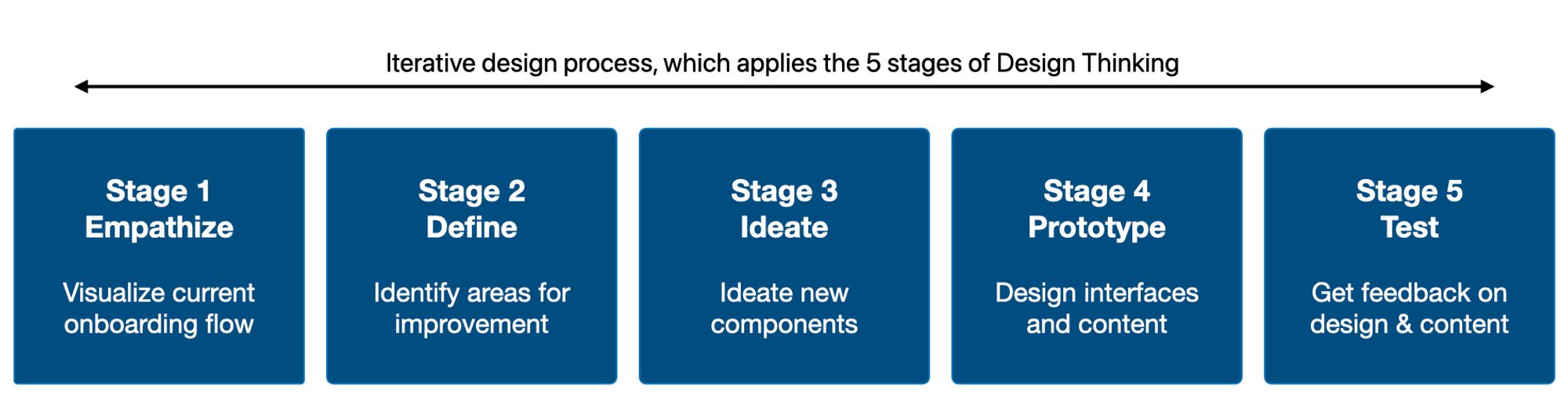
I applied the five stages of design thinking to this project.
Process
Stage 1: Empathize
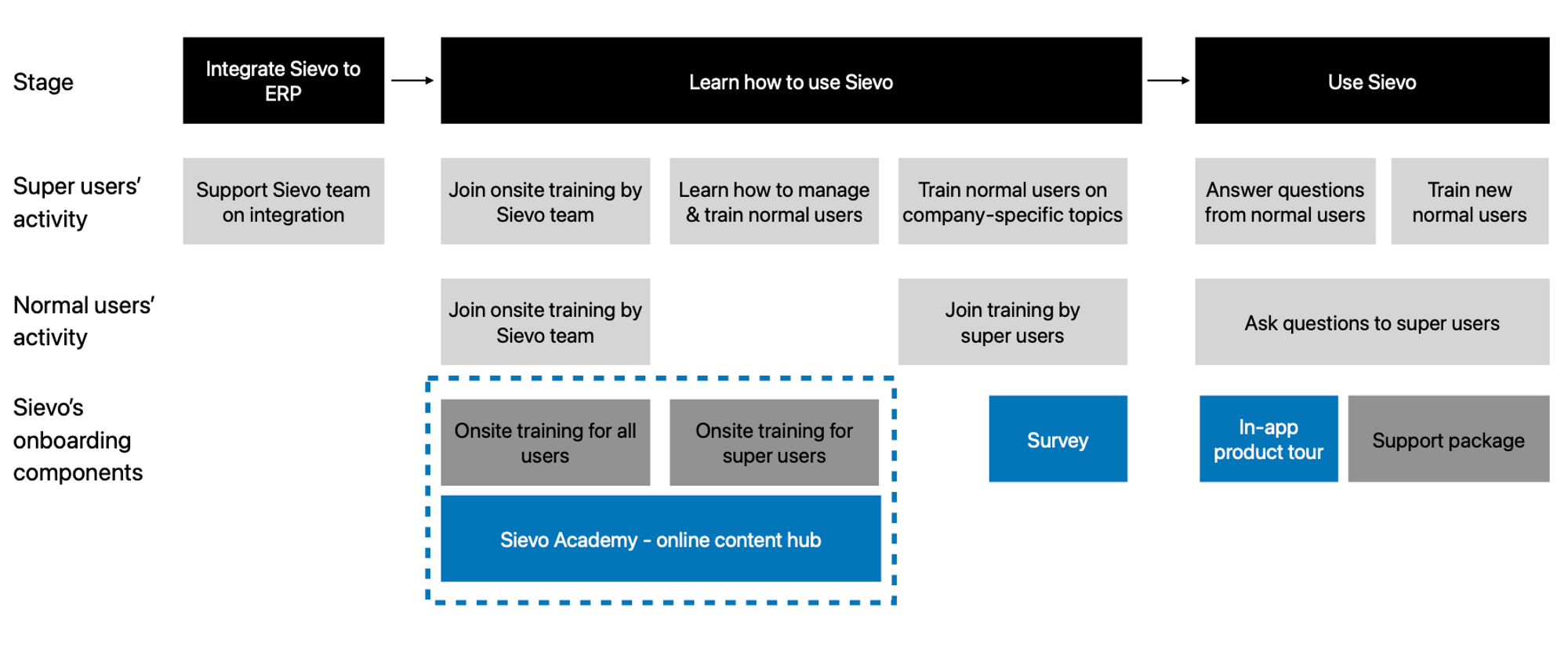
I conducted 10+ interviews internally to draw the existing onboarding flow.
From the interviews, I designed a complex service blueprint on FigJam to visualize the existing onboarding flow.
However, the service blueprint gets very complicated with two user types.
To simplify the onboarding flow to business stakeholders, I created a simplified user journey.
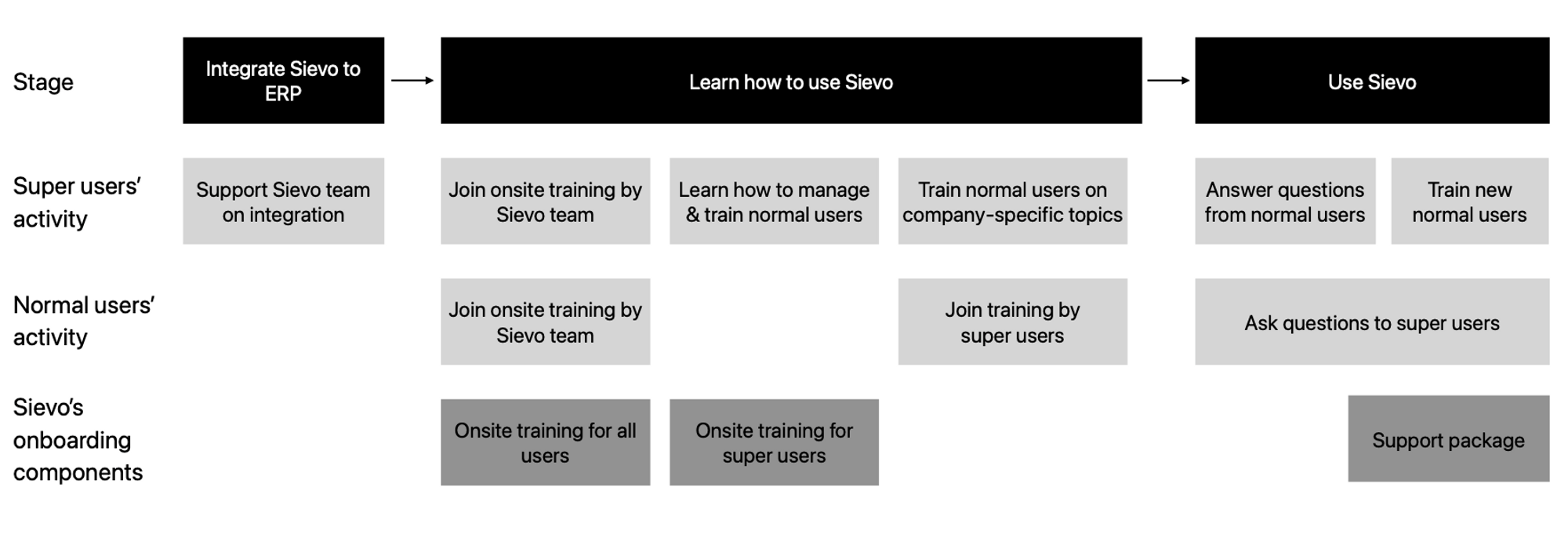
From the journey, we can see that Sievo uses “train the trainer” model.
Specifically, Sievo trains a few super users, then these super users will train the normal users. This model has both advantages and disadvantages.
Stage 2: Define
By having visibility on the current onboarding flow, limitations were identified.
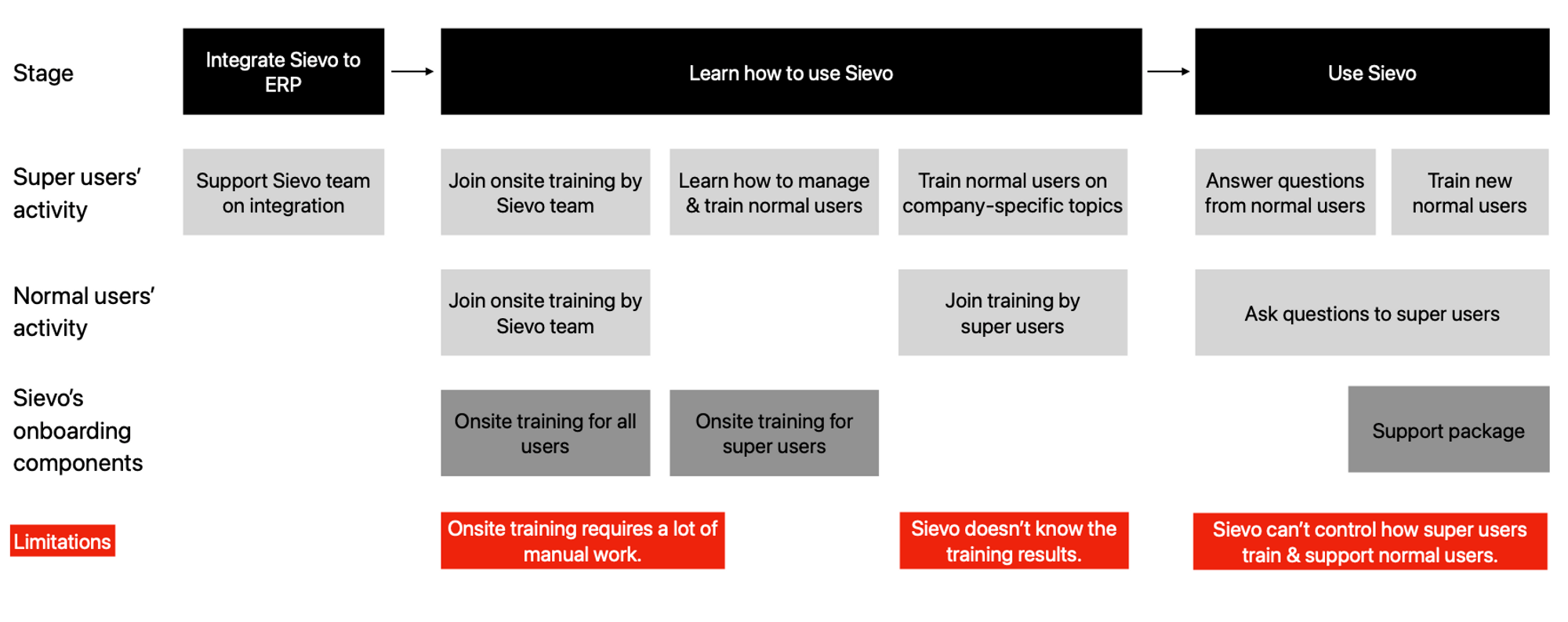
There were three main limitations.
- Onsite training requires a lot of manual work because the training content needs to be tailored to each customer.
- Sievo doesn’t have full visibility on how super users train normal users and whether normal users are ready to use the software.
- Most questions and issues about the software will come to super users first, and Sievo doesn’t know if these questions and issues are handled properly.
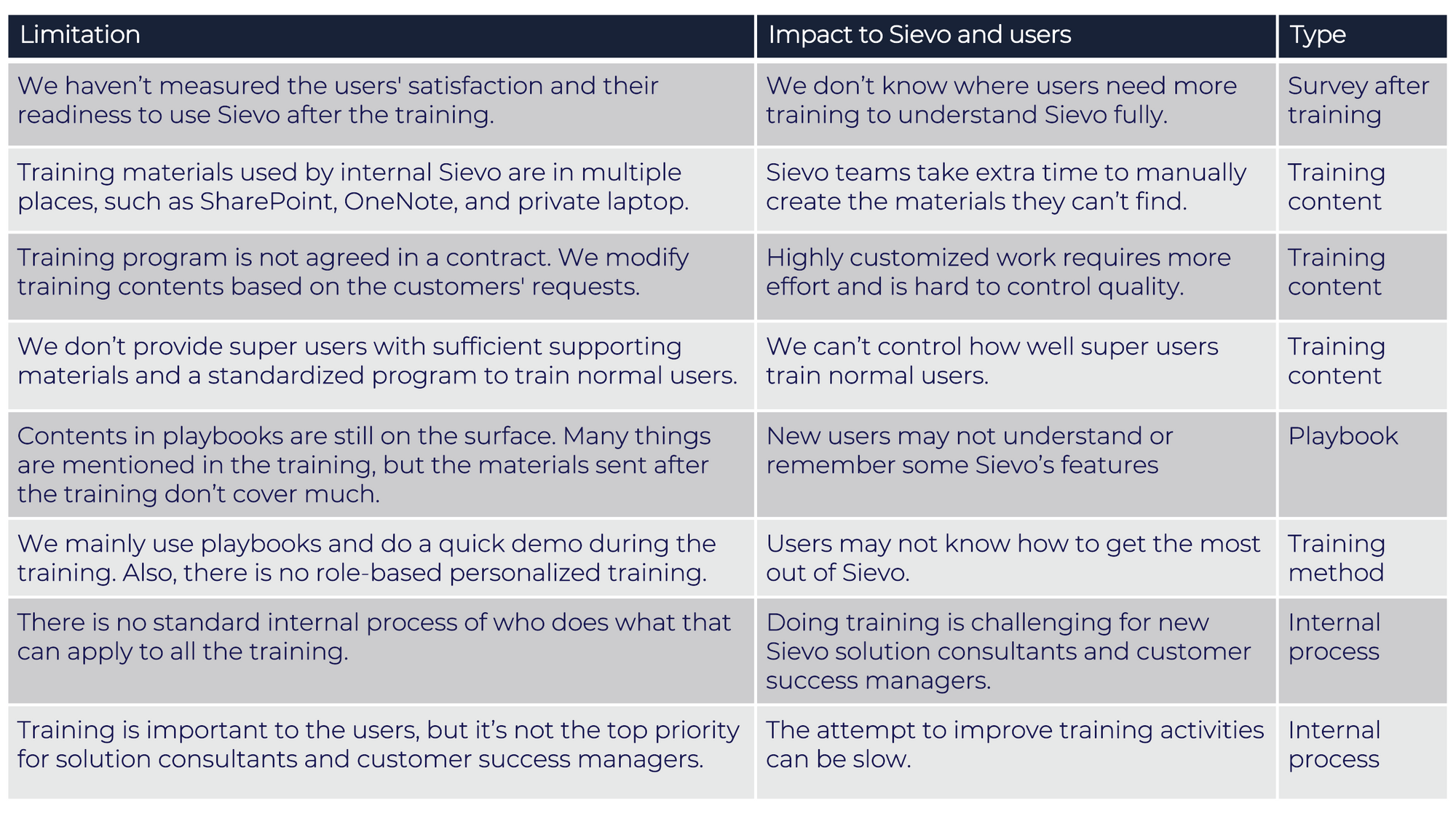
Then, I reviewed the current training program for all users and identified many limitations. These limitations were categorized into 3 types: survey, training content, and internal process.
Stage 3: Ideate
New components were added to the existing flow.
#1: Sievo Academy
It’s an online hub for educational content. Sievo Academy provides standardized training to super users and normal users, thus helping Sievo reduce the manual workload for onsite training.
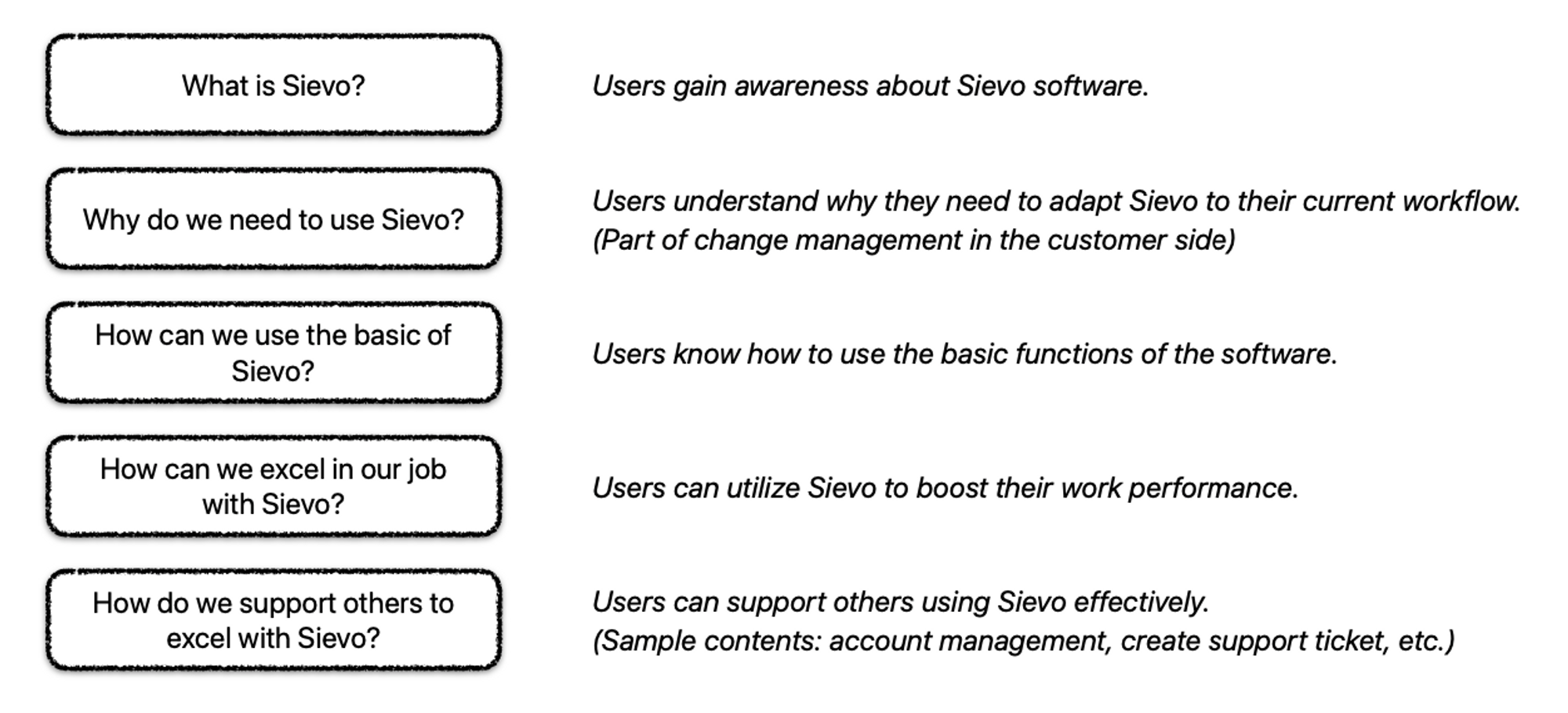
I defined 6 levels of users’ understanding from beginners to experts to help Sievo plan which content to produce.
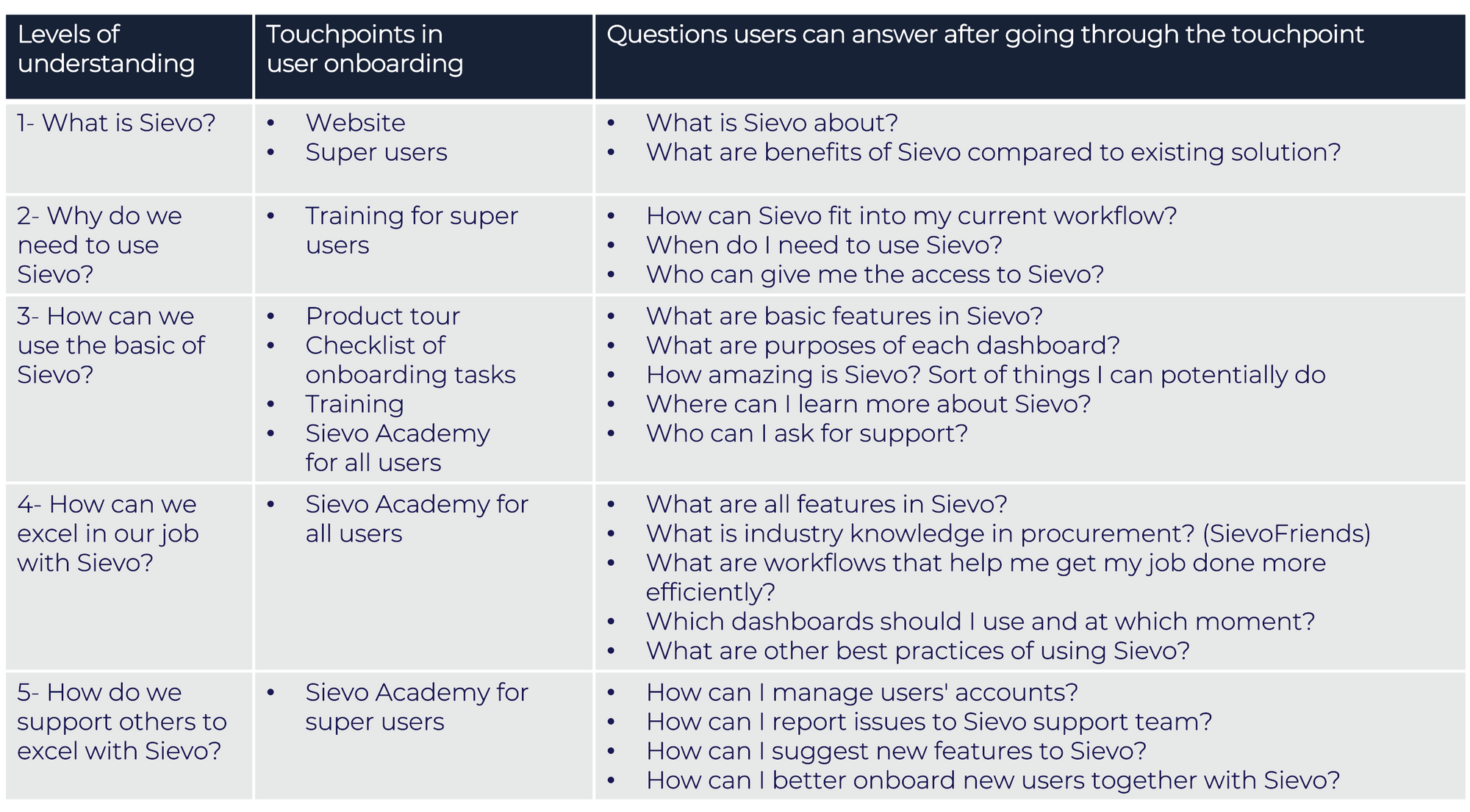
I also proposed the onboarding content for each level.
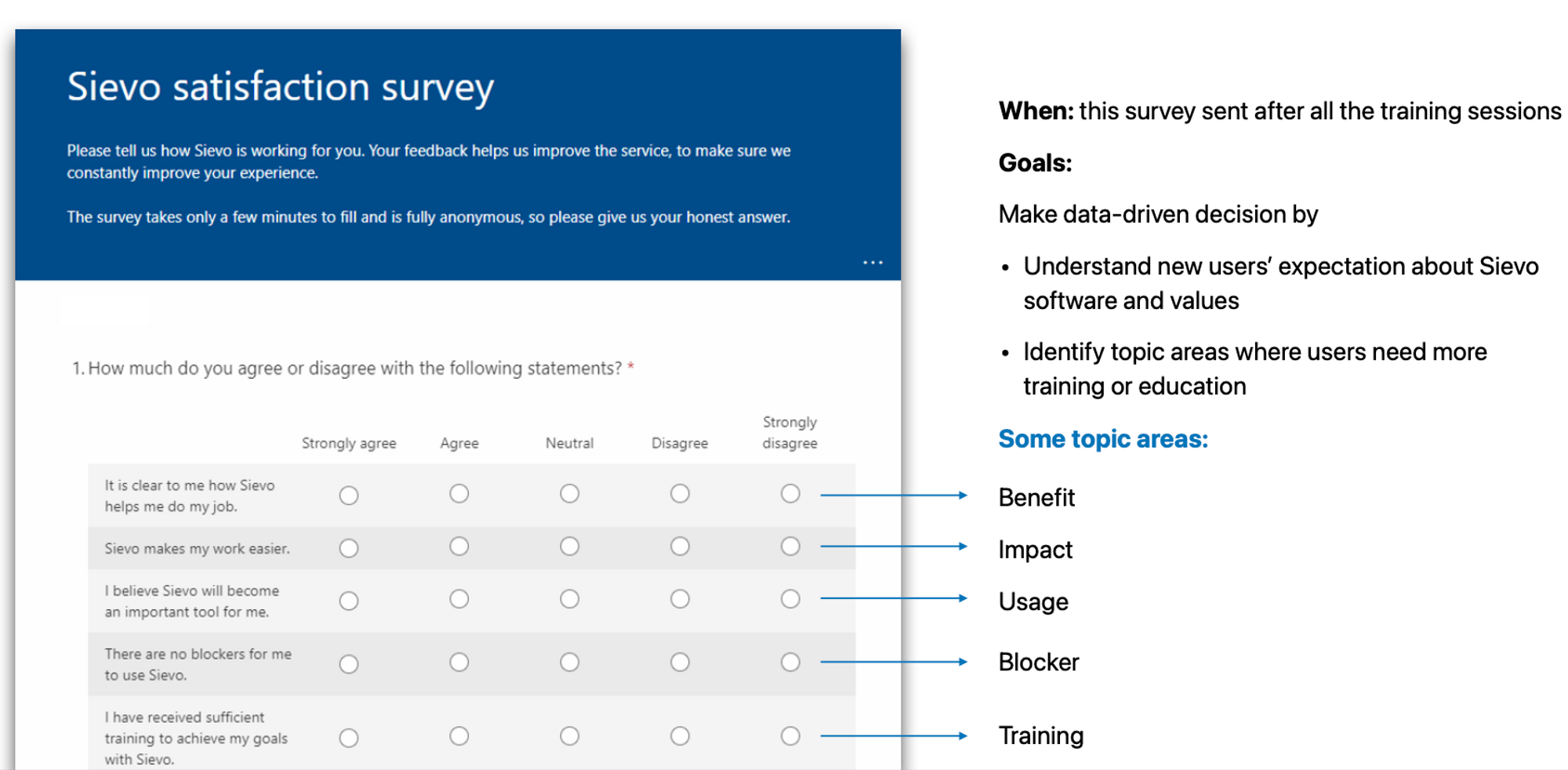
#2: Survey
The survey is created to measure users’ satisfaction and readiness after receiving all training.
Each question represents one area. Thus, after looking at the survey results, Sievo can identify which areas to improve.
#3: In-app product tour - including the first login page, product tour, and onboarding checklist.
These three components cover the beginning, middle, and end of the tour, which ensures new users have proper standardized training about the Sievo application.
Stage 4: Prototype
I used Figma to prototype three new components under the in-app product tour
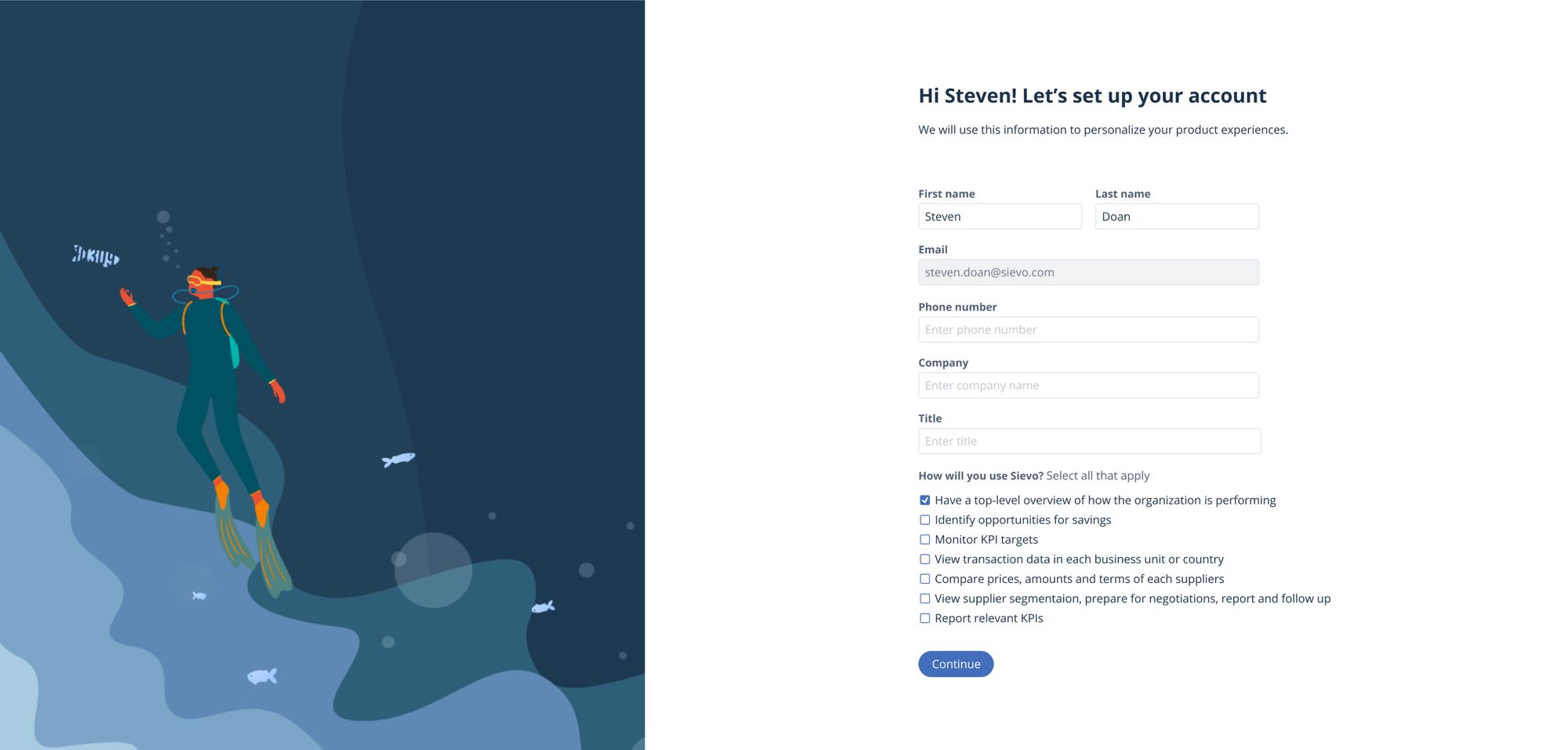
#1: First login page
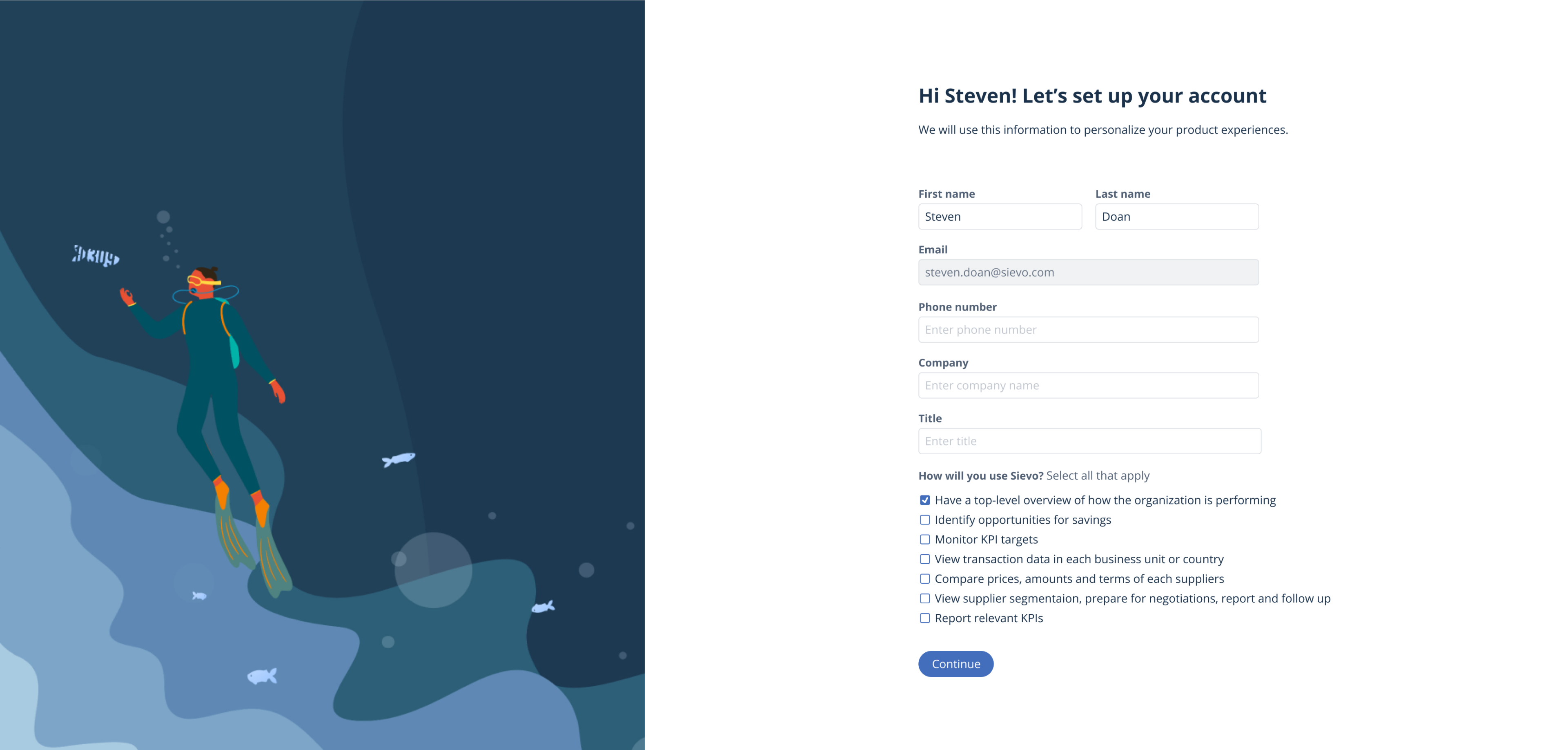
I redesigned this page by adding the question “How will you use Sievo?”. The purpose is to understand the users’ expectations of the software, providing context to analyze user feedback.
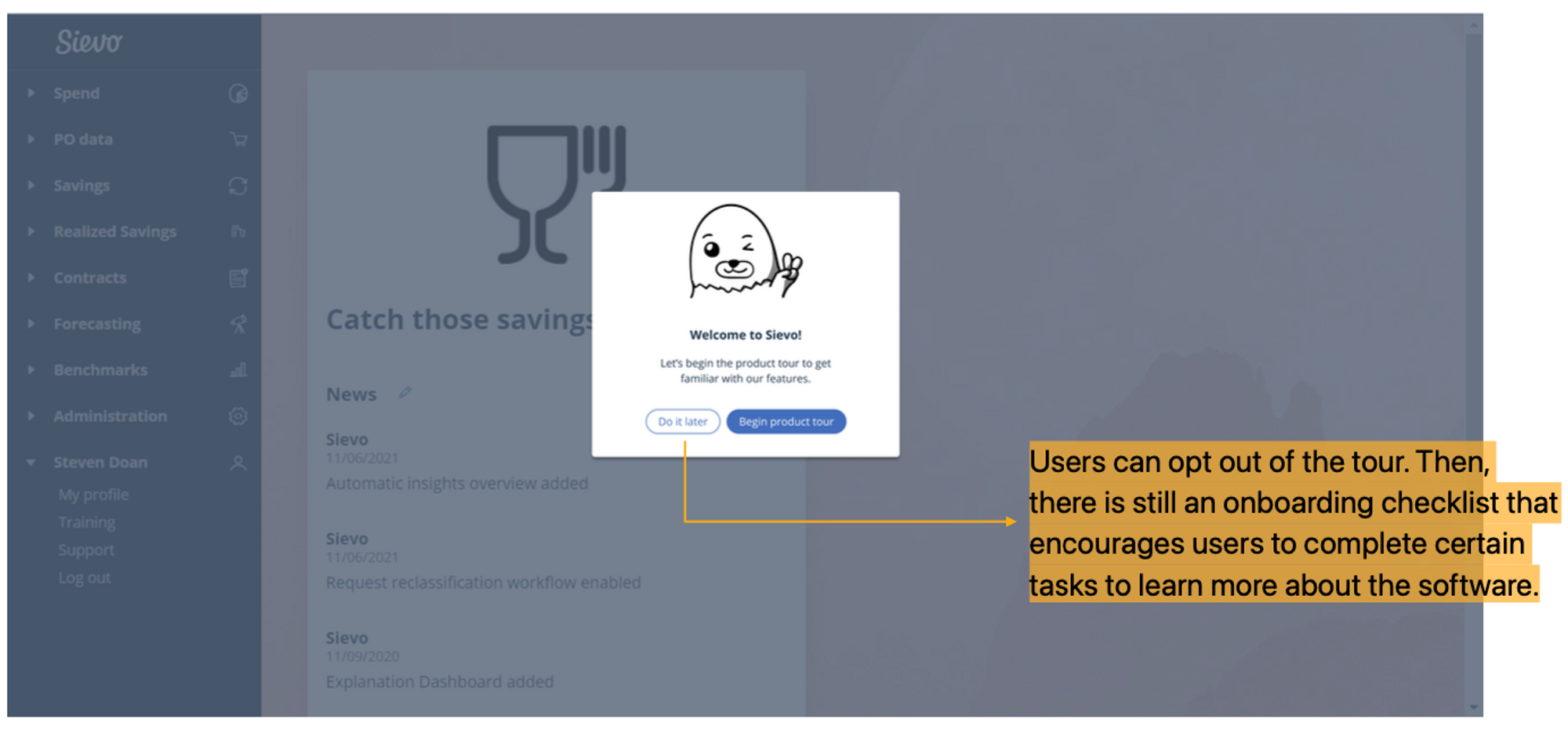
#2: Product tour
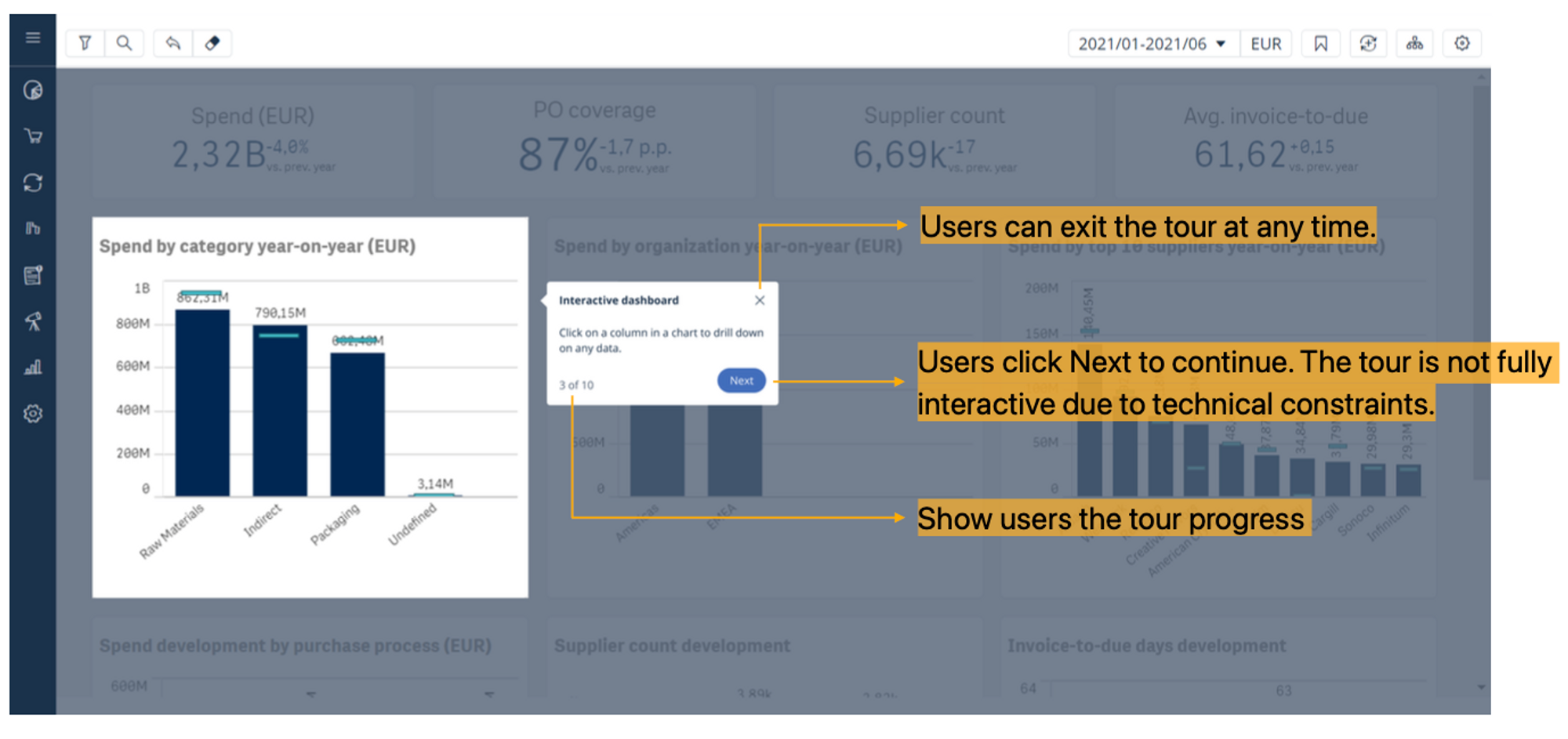
This tour will guide users through the 10 basic features of the software. Users can opt out of the tour at any time.
This screen introduces users to interactive dashboards on Sievo.
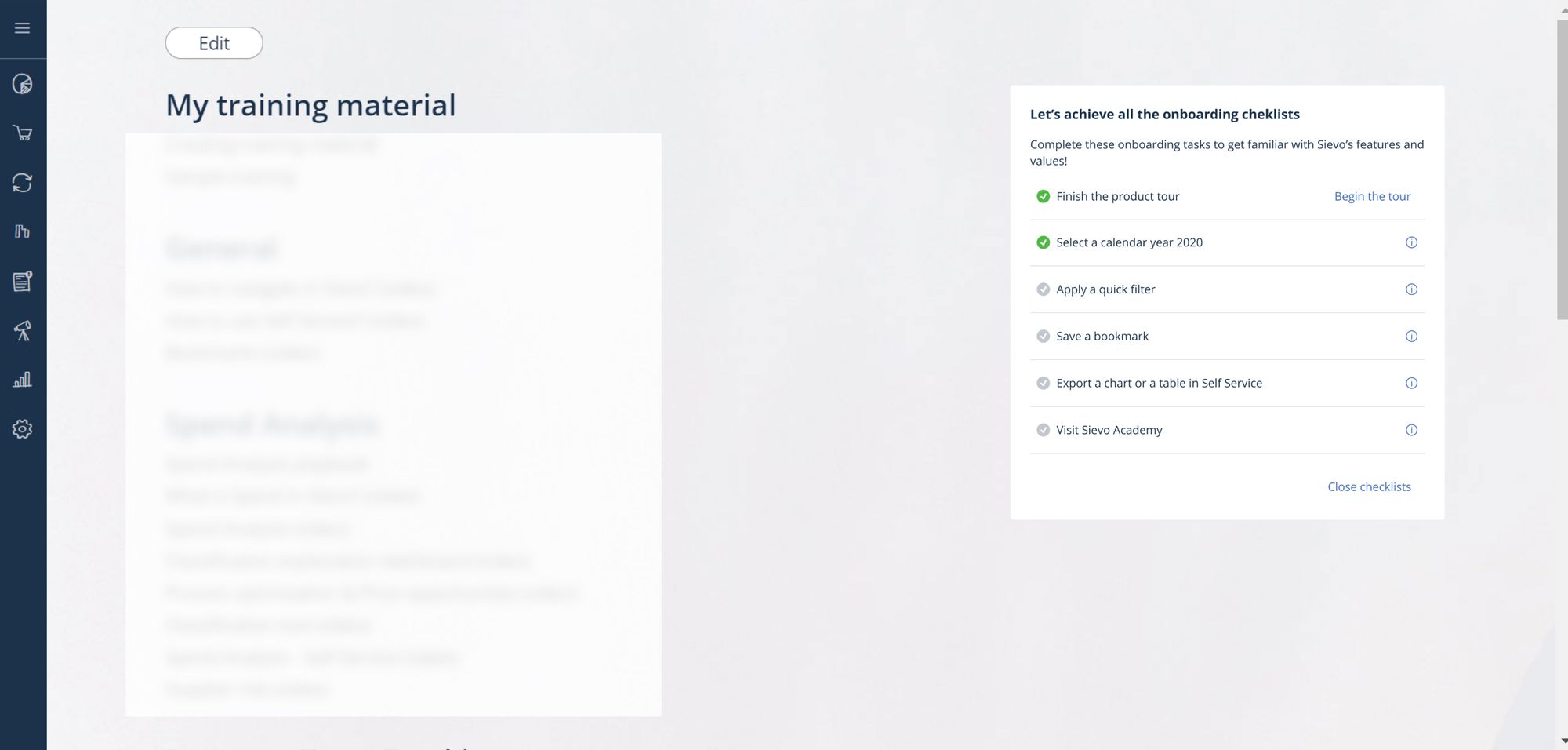
#3: An onboarding checklist
This checklist encourages users to complete certain tasks to get familiar with Sievo’s features.
Stage 5: Test
The content of the in-app product tour was validated by Customer Success Managers
I walked them through the in-app product tour and collected their feedback on the content. In general, the feedback was pretty positive.
Result
1. Design a holistic onboarding flow for new users with added components
- An Academy and a survey support Sievo in reducing the manual training workload.
- An in-app product tour helps users get the most value from the software, thus increasing the software usage.
2. Provide visibility on the current onboarding process, which is divided among different teams
3. Lay the foundation for further development. A year later:
- Sievo launched Super User Certificate in Sievo Academy: https://sievo.com/careers/life-at-sievo/sievo-academy-proudly-presents-the-super-user-certificate-in-spend-analytics
- The Head of Design published the step-by-step guide for user onboarding: https://sievo.com/careers/life-at-sievo/making-happy-users-in-three-steps
- An in-app product tour was introduced in Sievo Friends, an annual event for Sievo's customers and partners.
Lessons Learned
#1: Design a holistic onboarding experience
Onboarding is an important part that ensures new users get the most value from the product. After the project, I summarize my approach to designing better onboarding experiences.
- Understand the product and how users are using the product. For example, I’ll talk to different internal departments to see their views on the product and users. This step can be lengthy, so I must prioritize the areas I want to learn.
- Visualize the current onboarding process with both online and offline touchpoints. It’s also important to mention the team responsible for each touchpoint.
- Find a way to communicate the current onboarding to different stakeholders in the company. Then, they can help validate the current hypotheses and identify the pain points.
- Identify the critical improvement areas
- Brainstorm solutions and try to involve different stakeholders in the brainstorming process
- Design the solutions. Sometimes, using an available solution is easier than developing it from scratch.
- Define success metrics for these solutions
- Test the solutions internally and externally
#2: The design process can start with prototyping instead of extensive research
Research can take an enormous amount of time for projects with vague scopes as they are many things to study. In this project, my mistake was that I kept interviewing people without a clear goal of what I wanted to know. It was a nature of exploration, but I think this activity could be more efficient. For example, I could go crazy with my prototypes and let the stakeholders tell me the limit. By doing that, I can narrow the scope quickly and get buy-in from others.

